An agentic operating platform for specialty care.

AccesslyCare turns EHR data and deterministic clinical protocols into agentic workflows that extend specialist capacity — so patients reach the right care faster, diagnostic spend stays disciplined, and specialists spend their time where it matters most.

01
Data foundation
Epic Clarity, FHIR, labs, referrals, longitudinal journey
02
Protocol layer
Deterministic, specialty-specific workup logic
03
Application layer
Referral triage & panel management agents
04
Measurement layer
Avoided visits, spend, time to resolution
The bottleneck

Specialist capacity is the scarcest resource in the system.

Referrals pile up, panels go unmanaged, and the wrong diagnostics get ordered along the way. Patients wait, spend climbs, and specialists spend their license on work that protocols could route.

i.

Referrals outpace supply

Every specialty is capacity-constrained. A large share of referrals don't actually need an in-person specialist visit — but there's no scalable way to tell which.

ii.

Diagnostics drift

Without enforced protocols, workups are inconsistent: unnecessary panels and extra markers get ordered, and the right test is often delayed.

iii.

Panels go unmanaged

Surveillance, repeat labs, and follow-up gaps fall through the cracks — operational work that protocols handle well, but humans can't track at scale.

Proven in production

Built and validated inside Kaiser Permanente.

AccesslyCare's first specialty wasn't prototyped in a lab. It was developed on a deterministic protocol authored by practicing specialists, then validated inside live referral and panel workflows across Northern California.

Clinician-authored protocol

The hematology workup logic was written by practicing specialists — explicit and reviewable, not inferred by a model.

Live clinical operations

Validated inside real referral triage and panel management, measured against real operational outcomes.

Integrated-system scale

Deployed across Kaiser Permanente in Northern California — one of the largest integrated delivery systems in the country.

How it works

One platform, four layers — deployed per specialty.

AccesslyCare isn't a one-off workflow tool. It's a standardized operating platform: ingest the data, apply the protocols, run the workflow, and measure the result — repeatable across service lines.

01

Data foundation

Ingests relevant Epic Clarity, FHIR, lab, referral, encounter, scheduling, and longitudinal patient data into a specialty-aware model.

Hematology exampleIdentify hematology referrals, prior workups, relevant lab history, and the full patient journey.
02

Protocol layer

Stores and applies deterministic, specialty-specific protocols — explicit and authored by specialists, so every routing decision is traceable and clinically defensible. Over time it helps infer protocols from ongoing clinical data.

Hematology exampleApply workup logic to determine what data is missing and what the appropriate next step is.
03

Application layer

Builds agentic workflow applications that alleviate bottlenecks for specialists, APPs, MAs, and operational teams.

Hematology exampleReferral triage and panel management agents that act inside existing clinical workflow surfaces.
04

Measurement layer

Tracks operational and financial ROI, usage, and workflow performance over time — so impact is provable, not anecdotal.

Hematology exampleAvoided visits, reduced inappropriate panels, time to resolution, specialist capacity impact.
Applications

Two workflows, live in hematology.

The first end-to-end build focuses on the two highest-leverage surfaces — the same pattern then extends to every specialty on the roadmap.
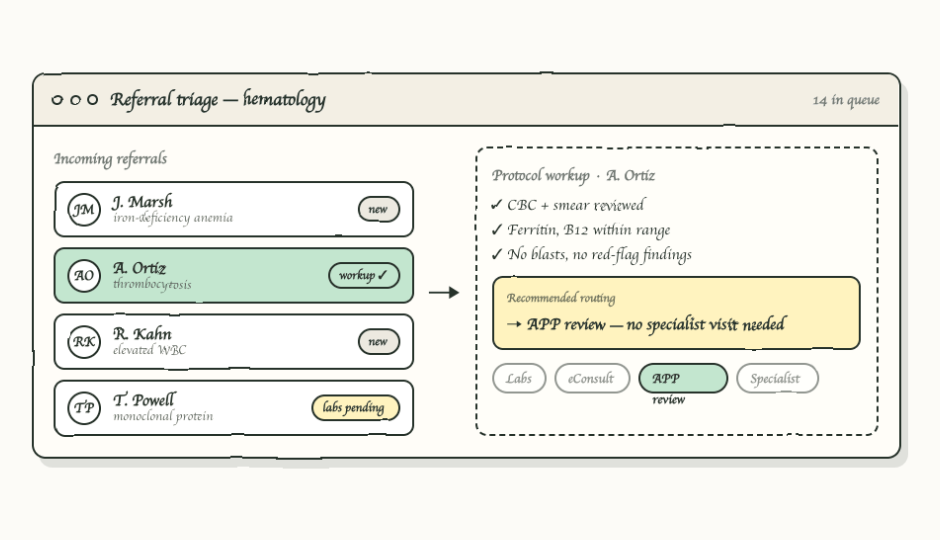
Referral triage workspace mockup

Referral triage

Uses referral data, lab history, and hematology protocols to determine whether a patient needs additional labs, APP review, eConsult/advice, or an in-person specialist visit.

  • Run the incremental workup automatically against the protocol
  • Route each referral to the right level of care
  • Send patients into their first specialist visit fully prepared
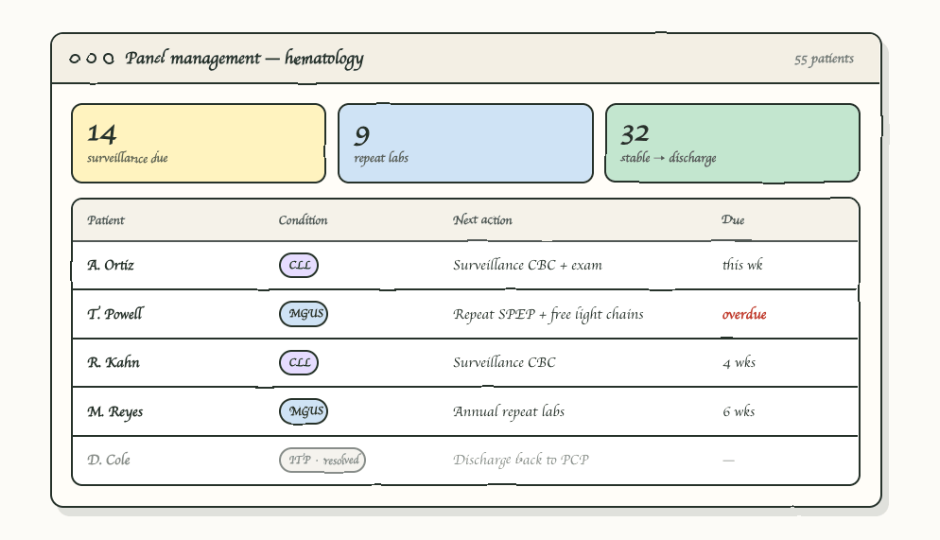
Panel management console mockup

Panel management

Keeps the hematology panel on protocol cadence — surfacing who's due for surveillance, repeat labs, or discharge across cohorts like CLL and MGUS.

  • Track CLL and MGUS surveillance cohorts against protocol cadence
  • Prioritize patients by risk and time-sensitivity
  • Resolve and discharge stable patients back to primary care
ROI · for your economic model

Proven ROI — whether you bear risk or bill fee-for-service.

AccesslyCare improves the underlying operations of specialty care, then measures the result. The proof is the same; the value simply lands where your incentives are.

80%

of referrals were resolved without a specialist visit after an incremental, protocol-driven workup — Kaiser Permanente, Northern California pilot.

Proven in production

Clinical data drives the action — and the ROI.

AccesslyCare doesn't just surface cohorts and insights. It determines what operational action should happen next, then measures whether that action improved cost, access, and specialist capacity.

Avoided visits

Fewer unnecessary in-person specialist appointments, freeing slots for patients who truly need them.

Disciplined spend

Reduced inappropriate diagnostic panels and extra markers through standardized workups.

Time to resolution

Faster, better-prepared first visits and quicker paths to a definitive answer for patients.

Specialist capacity

Specialist time reserved for higher-value, higher-acuity care that requires their license.

The same proof, valued two ways
Risk-bearing / value-based

Lower total cost of care.

When you own the medical expense, every avoided visit and unnecessary diagnostic is margin. AccesslyCare keeps utilization disciplined and capacity focused on rising-risk patients.

  • Reduce avoidable utilization — divert referrals that don't need a specialist visit, and cut unnecessary panels and markers.
  • Bend diagnostic spend — standardized workups stop redundant and out-of-sequence testing.
  • Close care gaps proactively — panel management surfaces surveillance and follow-up before they escalate.
  • Protect capacity for the sickest — reserve scarce specialist time for the highest-risk members.
Fee-for-service

More access, better throughput.

When access is the constraint, AccesslyCare expands effective specialist capacity — converting triage and panel work into more high-value visits and less leakage.

  • Expand specialist capacity — protocol-driven triage lets each specialist see more of the patients who need them.
  • Reduce referral leakage — keep appropriate patients in-network with faster, smarter routing.
  • Higher-value visit mix — offload low-acuity triage so clinic time goes to complex, billable care.
  • Faster access & satisfaction — shorter waits and prepared first visits improve patient and referrer experience.
Specialty roadmap

Prove it once. Repeat it across service lines.

Hematology validates the full stack. Oncology proves adjacent extensibility. Cardiology and beyond test broad repeatability — all on the same four layers.

Live pilot

Hematology

referral triage · panel management

The proven wedge. Deterministic workup logic already demonstrated clear ROI on time-to-resolution and diagnostic spend in Northern California.

Expansion

Cardiology & beyond

cardio · nephro · +

Broad repeatability across specialties where capacity, diagnostic spend, and panel management are the major operational pain points.

Extend your specialists' capacity.

See how AccesslyCare deploys on your data and your protocols — starting with one specialty, built to scale across your service lines.

Talk to us